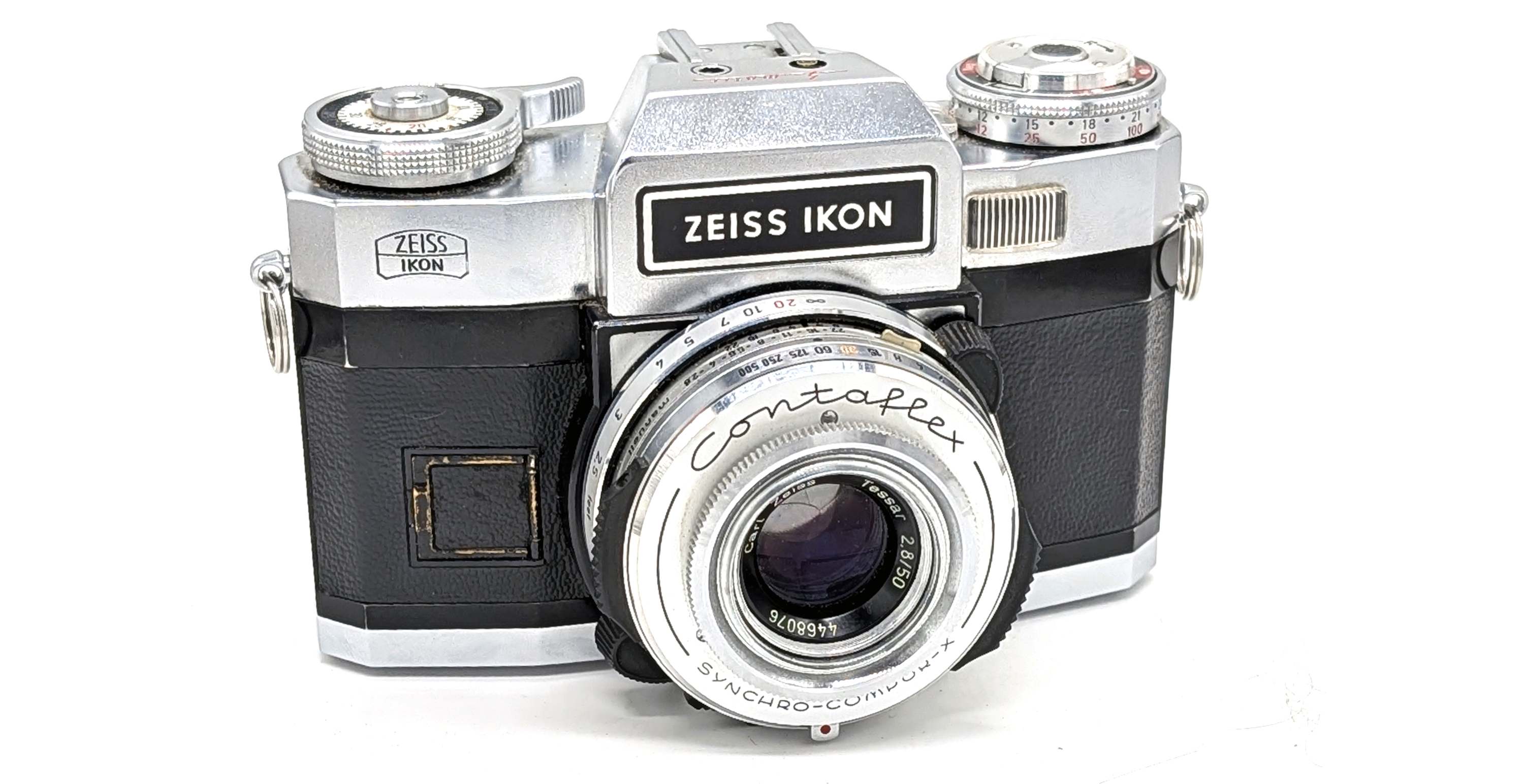
The 1965-71 Contaflex Super BC (aka the “Automatic S”) was the final model in a series of Zeiss Ikon-branded leaf-shutter SLRs. The Super BC’s claim to fame over prior Contaflex models was the addition of a battery-powered TTL light meter that could provide shutter-priority autoexposure. Like most Zeiss Ikon products produced at its height, the Super BC exudes exceptional build quality, impressive attention to detail, and typical West German over-engineering. Despite the fact that the Contaflex line offered only a limited number of lenses, a working Super BC is a joy to use even today.
By the close of the 1960s, Zeiss Ikon was producing under its own name three (arguably four) separate 35mm SLR camera lines: the “Contarex,” the “Contaflex,” and the “Icarex.” The Contarex was the top of the line, with a focal plane shutter and a wide range of extraordinary Zeiss-designed lenses. The Contaflex was a series of leaf-shutter SLRs first introduced in 1953. The Contaflex “Alpha / Beta / Prima” series were lower cost models that used a different shutter and its own lenses. The Icarex was a third line with focal-plane shutters and Voigtlander-designed lenses that came either in a proprietary bayonet mount or in M42. At the same time, Voigtlander was producing under its name the leaf-shutter “Bessamatics” and “Ultramatics.”
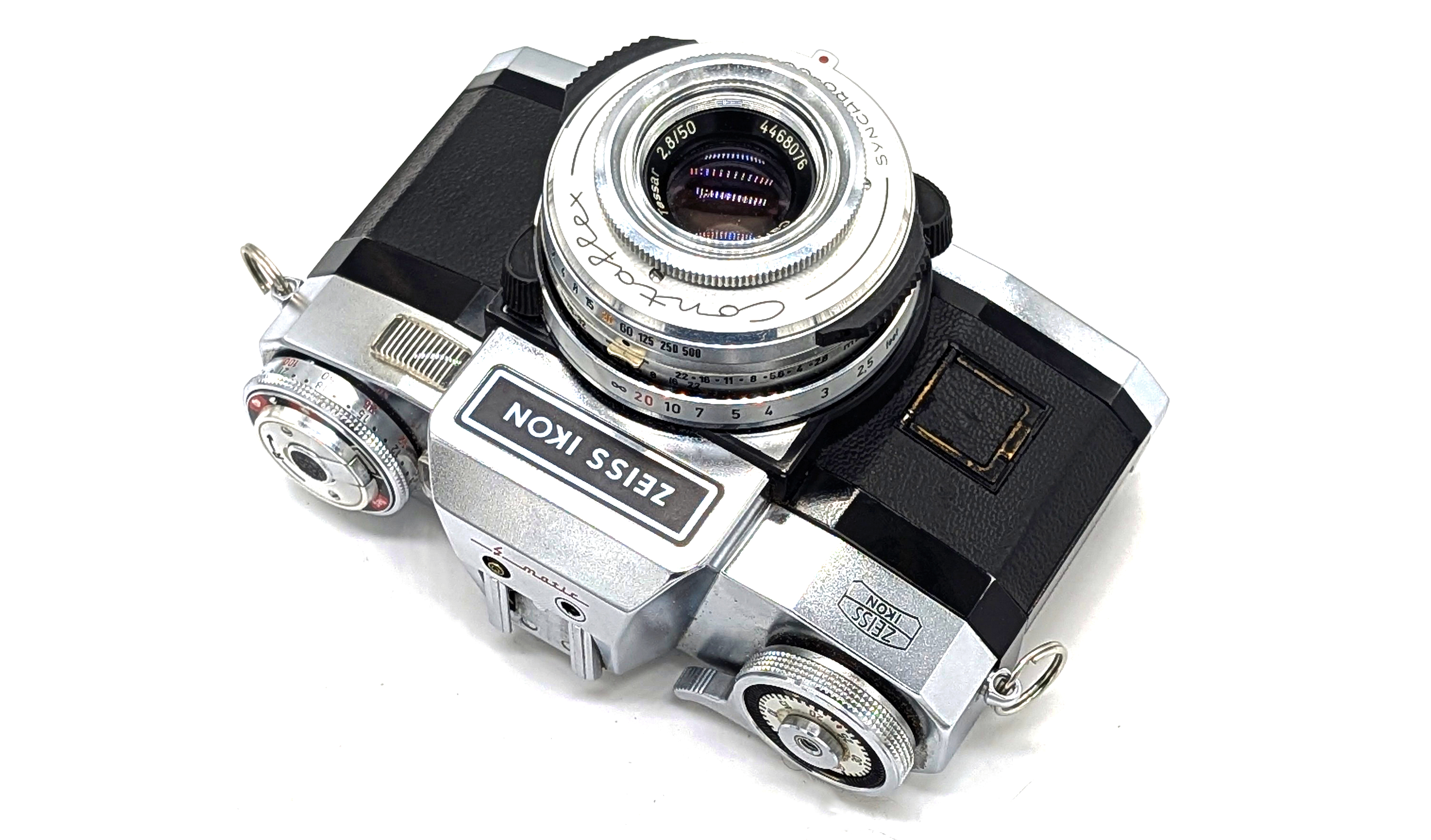
During the early 1970s, Zeiss Ikon abandoned all of these projects. In 1972, Zeiss sold the Voigtlander brand to Rollei, which continued the Icarex/SL706 line with the “Voigtlander VSL” and then the “Rollei SL” series of cameras. During 1973, Zeiss Ikon contracted with Yashica to produce a new SLR system (“Contax”) that would go on to repurpose many of the former Contarex lens designs. The Contaflex was left to die on the vine.
Leaf-shutter SLRs were fairly popular during the 1950s and early 1960s before the perfection of reliable focal-plane shutter cameras like the Nikon F. While leaf-shutter cameras have the arguable advantages of less “shutter shake,” the ability to flash sync at all shutter speeds, a relatively simple and common shutter that theoretically could be widely serviced, and more compact lens designs, they ultimately did not prevail in the 35mm marketplace (but certainly continued on in the medium and large format worlds).
The principal leaf-shutter, interchangeable-lens SLR camera systems of the era were the Zeiss Ikon Contaflex, the Voigtlander Bessamatic/Ultramatic, the Kodak Retina Reflex, and the Topcon Unirex. Other manufacturers like Kowa (SE/SE-T) and Minolta (ER) had their own models, neither of which had true interchangeable lenses (using screw-on accessories instead) nor were broadly successful. Here are some comparisons of the ultimate leaf-shutter models from the major manufacturers.
| Super BC | Ultramatic CS | Bessamatic CS | Retina Reflex IV | Unirex | |
| Years Produced | 1965-71 | 1965-69 | 1967-69 | 1964-67 | 1969-73 |
| Mount | Proprietary | DKL | DKL | DKL* | Proprietary |
| Autoexposure? | Shutter Priority | Shutter Priority | No | No | Shutter Priority |
| Metering | Internal CdS | Internal CdS | Internal CdS | External Selenium | Internal CdS (Center & Spot) |
| Shutter Speeds | 1 sec. – 1/500 | 1 sec. – 1/500 | 1 sec. -1/500 | 1 sec. – 1/500 | 1 sec. – 1/500 |
| Shutter | Synchro-Compur | Synchro-Compur | Synchro-Compur | Synchro-Compur | Seikosha SVL |
| Screen | Split & Microprism Collar | Split | Split | Split | Microprism |
| Viewfinder | Aperture & Shutter Speed | Aperture, Shutter Speed, Exposure Mode | Aperture & Shutter Speed | Aperture & Shutter Speed | Aperture |
| Auto Mirror Return? | No | No | No | No | Yes |
| Battery | PX625 | PX625 | PX625 | None | PX625 |
* Although Voigtlander and Kodak models use a similar type “DKL” mount, the lenses are not interchangeable.
Operation
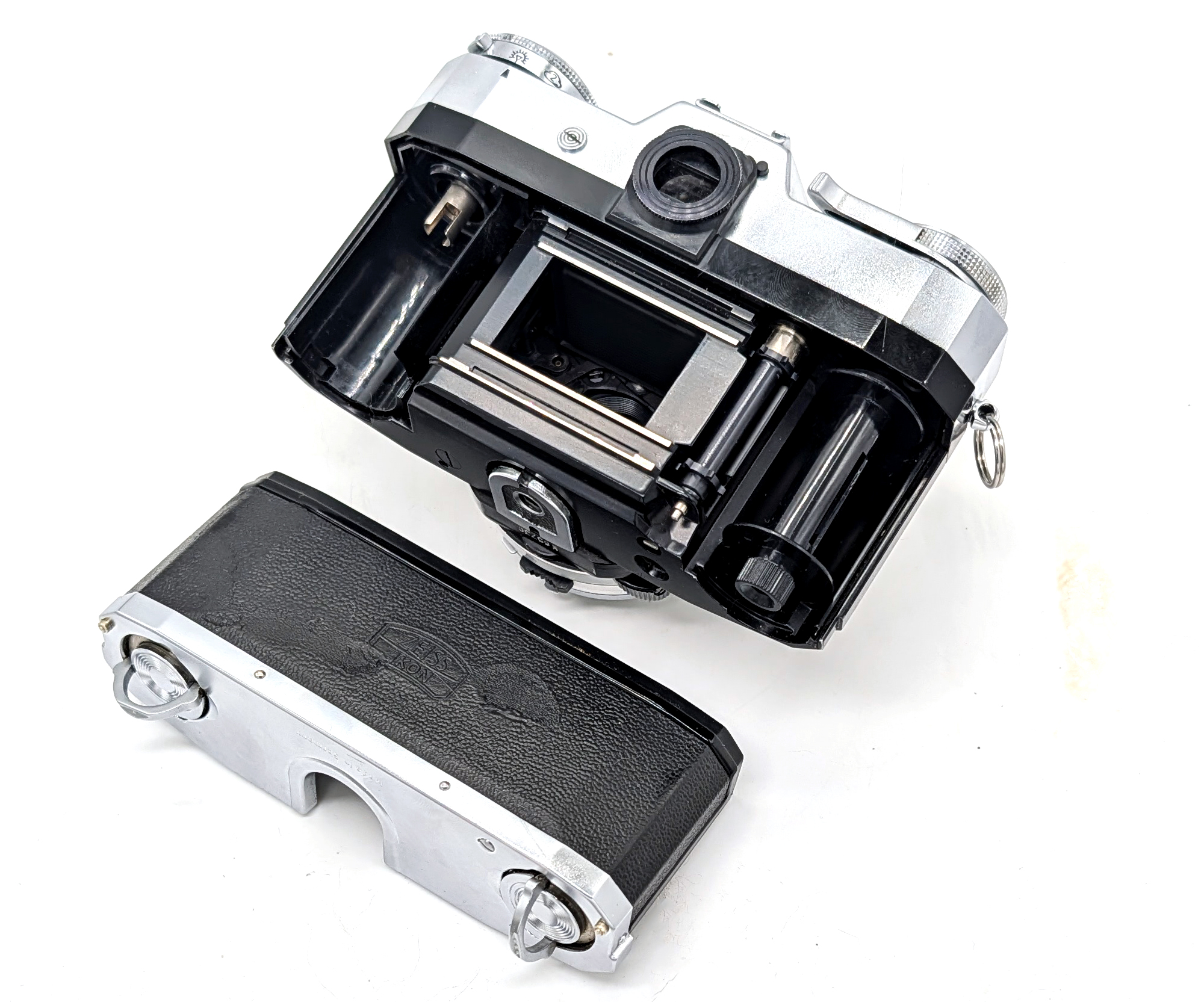
Reflecting its early 1950s design philosophy, the Contaflex is a somewhat complicated beast compared to later focal-plane SLRs. To load the film, the back of the body must first be unlocked and removed via keys on the bottom. The film speed is set by setting an arrow on a dial on the topside rewind crank. The film counter must be manually set with each roll and counts down, rather than up.
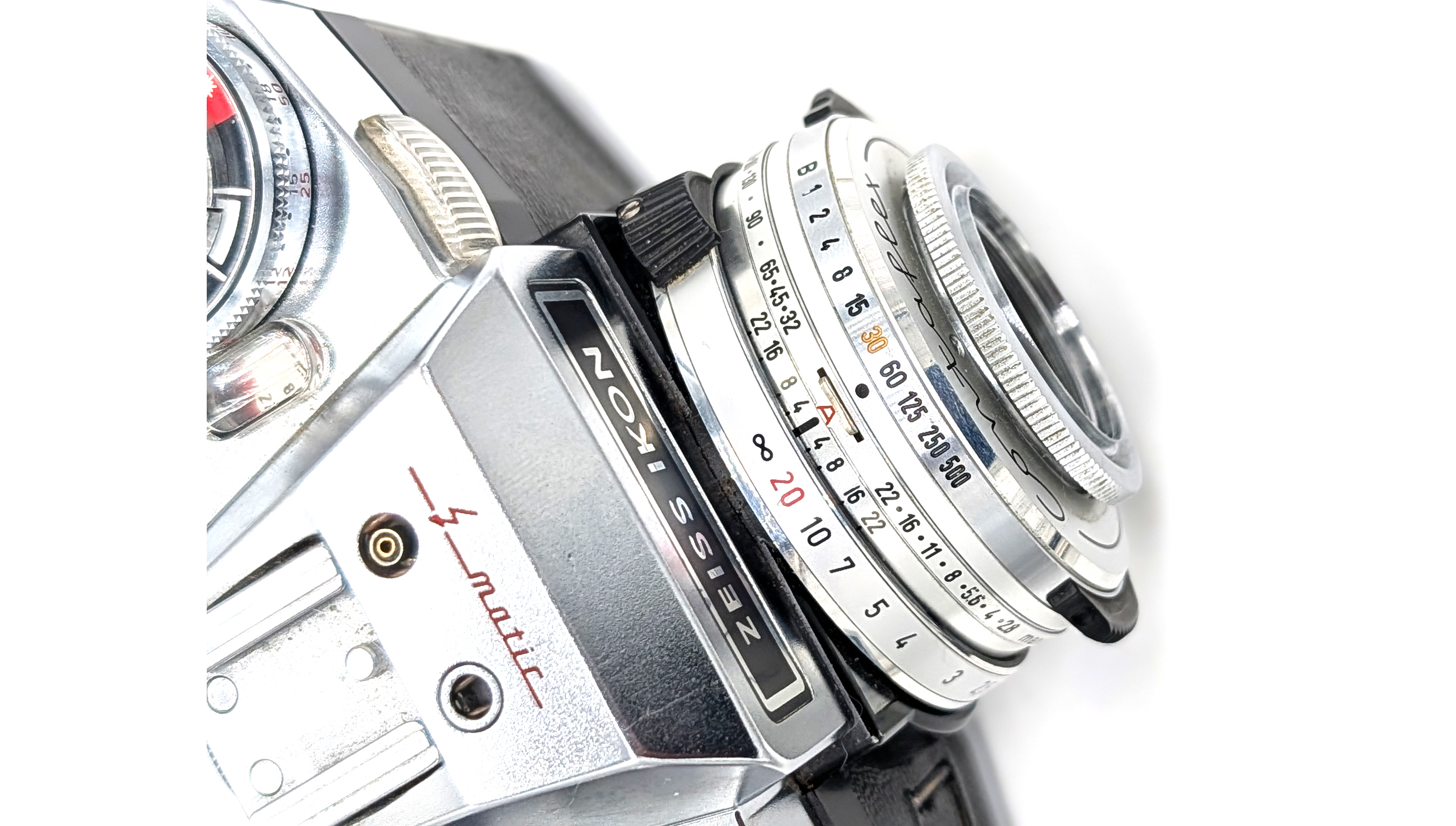
For the time, the most innovative feature of the Super BC was its internal TTL CdS light metering system to drive its shutter-priority autoexposure operation. During 1965, several other manufacturers introduced this feature on leaf-shutter cameras, notably the Kowa SE-T and the Voigtlander Ultramatic CS. By setting the ring on the lens mount to line up with an arrow, the camera will automatically set the appropriate aperture given the selected shutter speed. The camera-selected aperture will display both in the viewfinder and in a little window on the top of the camera body. If the meter reads underexposure, the body will default to the largest aperture when the shot is taken. Because there is no “exposure lock,” and to avoid possible over under-exposure, the Super BC has neat, unique feature where by moving and holding a ring to a cloud symbol (with the number “2” on it), the camera will add stops of exposure to the metered reading.
The focusing screen of the Super BC is decently bright with the standard 50mm f/2.8 lens, certainly not to any professional level, and includes a split-screen, a microprism collar, and the ground glass. The viewfinder displays the aperture range on the right side with a needle. In dark conditions, the aperture scale appears barely illuminated in the viewfinder and it is usually impossible to see the selected shutter speed. The Super BC also has a small window on the left-side top of the camera that displays the metered aperture.
Other the older-style interfaces, the Super BC operates pretty smoothly. The mirror does not automatically return upon firing the shutter and only mechanically returns when the film lever is advanced. The film advance is both dampened and has fairly long throw. Oddly, the leaf shutter is not particularly quiet as one would expect.
The Super BC uses the long-discontinued 1.35V PX625/PX13 mercury battery. To remedy his, both Wein cells and step-down voltage adapters available. I have found that the MR-9 adapter (that uses a 386 silver oxide battery) seems to work fine. It is important that when not in use to switch the meter off switching the aperture dial from the arrow. Otherwise, the meter may continuously operate.
The Contaflex uses a series of interchangeable lenses that share a common two group, three element optical configuration inside the lens mount itself. Unlike the relatively wide range of lenses available in the DKL mounts, the Contaflex has a rather limited selection: a 35mm, 45mm f/2.8 (older), 50mm f/2.8 (newer), 85mm, 115mm, and some accessory close-up lenses, including a 1:1 macro. The 35mm and 85mm came in two versions, an earlier f/4 and later f/3.2.
Here are the specifications for lenses for the system.
| 35mm f/4 (f/3.2) | 50mm f/2.8 | 85mm f/4 (f/3.2) | 115mm f/4 | |
| Design | 8 Elements, 6 Groups | 4 Elements, 3 Groups | 8 Elements, 6 Groups | 9 Elements, 6 Groups |
| Min. Focus | 0.4m | 0.7m | 1.7m | 3.0m |
| Filter Size | S49mm (f/4); S60 (f/3.2) | S27 or 28.5mm Push On | S60 | S67 |
It remains very impressive that Zeiss could design a number of quality lenses in different focal lengths around a fixed 3 rear element set. Having used the 50mm and 35mm f/3.2, both lenses perform extremely well, probably nearly as good as you are going to get for that era of manual-focus SLR lenses. The 35mm has an exceptional close focus ability down to 0.4m. For a proper Contaflex set, both the 50mm and 35mm are recommended. Although some like the 85mm, the consensus seems to be that the 115mm may not be worth it.
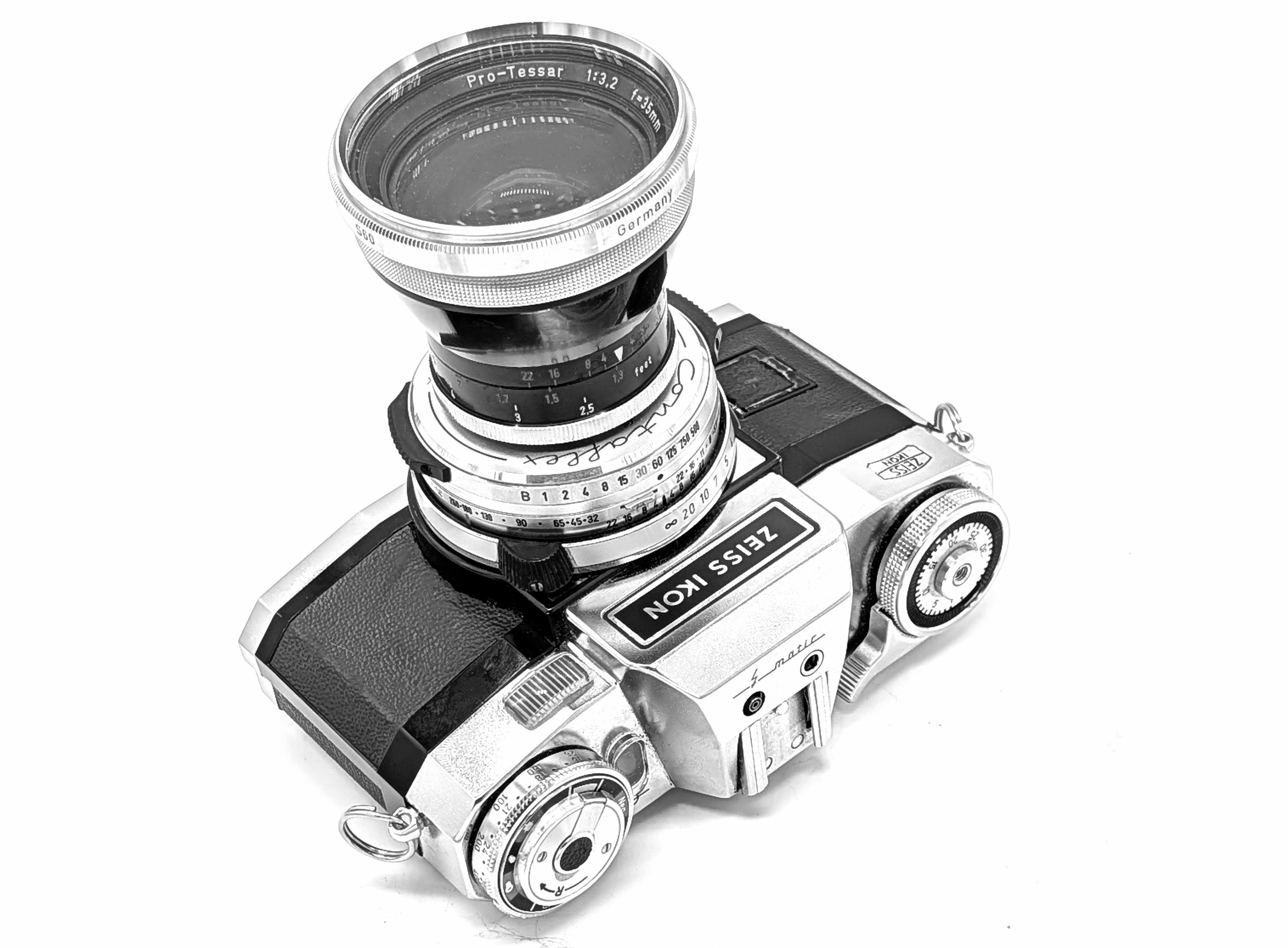
A drawback to the system is that Contaflex lenses do not take standard screw-in filters or lens hoods. A step up ring exists that allows the use of S60 filters on the 35mm f/4. Another drawback is that modern flashes using hot shoe adapters tend to fail to trigger the X-sync on the camera. It is likely that Contaflexes are among the types of cameras that require higher trigger voltages (or at least direct PC connections from the flash). The final weak point to its operation is the crammed placement of the focusing, aperture, and shutter speed dials on the relatively thin lens mount. The focusing knob can be difficult to find with your fingers when the camera is at your eye.
Given the large universe of alternatives, Contaflexes are probably not recommended for beginners. That being said, the best models to look for are the metered Super or the Super BC. Given the facts that both remain relatively affordable and autoexposure can make your life generally easier when you need it, there is nothing particularly desirable about either the non-metered or non-coupled earlier Contaflex bodies. For what it’s worth, the Super apparently has a noticeably brighter viewfinder than the Super BC because of the lack of a TTL prism metering system.
If you are looking for the best camera in this class and from this time period, that award may arguably go to the Voigtlander Ultramatic CS. The CS matches every feature of the Super BC with the further advantages of: (1) twelve compatible lenses in the 35-350mm range, including an early zoom ; (2) a traditional swing-back film door; (3) a regular film counter that is reset automatically; and (4) an allegedly brighter focusing screen. While I do not think that the design and build of the CS is as elegant as the Super BC, that may not matter to you. If looking for a more “modern SLR style” leaf shutter camera with autoexposure, the Topcon Unirex is another option.