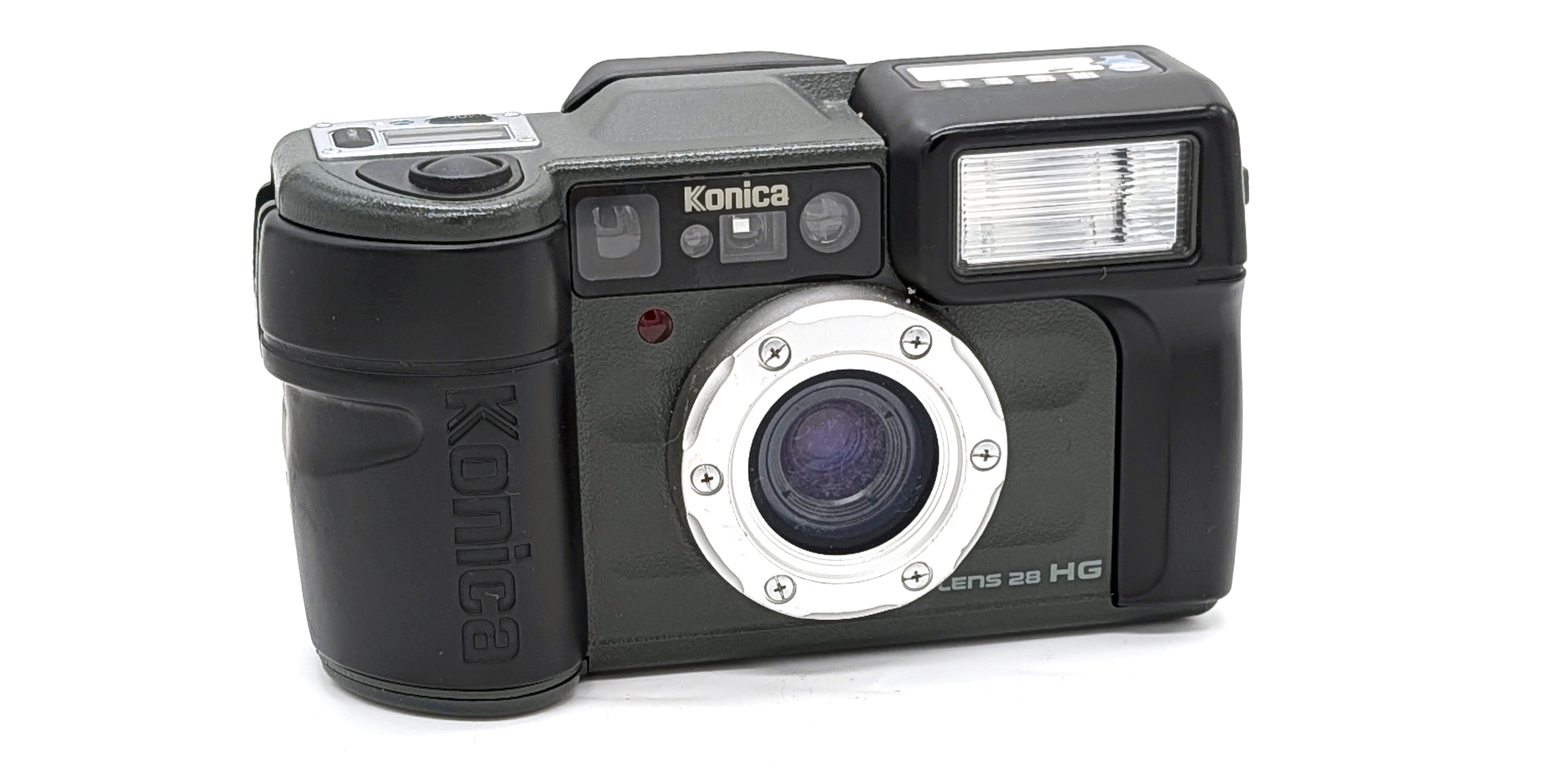
Beginning in 1988, Konica introduced a series of durable, weather-sealed point-and-shoots for construction and industrial uses in a variety of configurations and at different focal lengths. The Genba Kantoku 28HG was one of the final models. With some impressive features, including a high-quality, close-focusing 28mm lens, the 28HG makes a good case for being a fantastic “take everywhere” camera.
Konica appears to have produced three primary versions of Genba Kantoku bodies with a 28mm f/3.5 lens. Here is a comparison. The 1992 “28 New” is left off the list as it is similar to the 28WB.
| Wide 28 | 28WB | 28HG | |
| Year | 1990 | 1994 | 1994 |
| Weight | 400g | 350g | 375g |
| Lens | 28mm f/3.5 | 28mm f/3.5 | 28mm f/3.5 |
| Lens Design | 8 Elements, 7 Groups | 5 Elements, 5 Groups | 5 Elements, 5 Groups |
| Minimum Focus | 0.75m Separate Close-Up Mode 0.5-0.75m | 0.5m | 0.4m |
| Focus/Exposure Lock? | Yes | Yes | Yes |
| ISO Range | 25-3200 | 25-3200 | 25-3200 |
| Default for Non-DX | 25 | 25 | 25 |
| Shutter Speeds | 1/4 – 1/280 | 1/4 – 1/280 | 1/4-1/280 |
| Exposure Comp Mode? | None | ? | Yes +2 |
| Water Resistance | Class 4 | Class 7 | Class 7 |
| Panoramic Mode? | No | No | Yes |
| Battery | 2CR5 | 2CR5 | 2CR5 |
It appears that the Genba Kantoku series represents an evolution of prior Konica point-and-shoot models such as the MG and the MT series. I do not see much similarity in external or internal design between the Genba series and the 1992 Konica Hexar AF. Although the 28WB and 28HG have similar specifications, the bodies are different. The 28HG has a different built-in flash, and its viewfinder was moved from to the left of the autofocusing sensors to in-between them.
The 28HG has a fixed 28mm f/3.5 lens that focuses down to a very impressive 0.4m. While many 28mm lenses out there suffer from some degree of barrel distortion, the 28HG produces a remarkably flat image. The lens performance of the 28mm is pretty good and certainly better than the vast majority of film point and shoots. Its shutter speeds range from 1/4 to 1/280. It requires the use of DX-coded cartridges or otherwise will default to ISO 25.
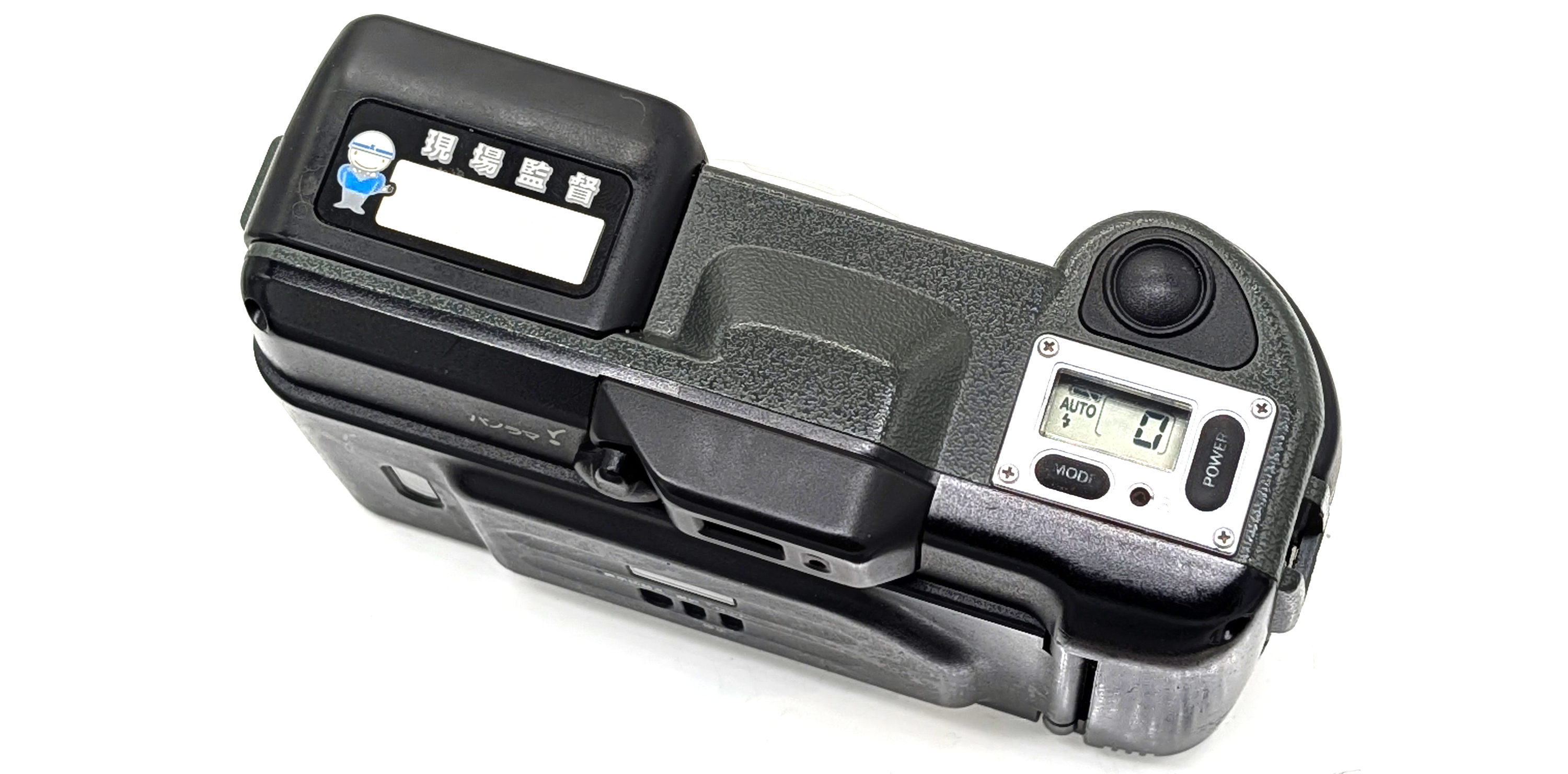
The 28HG’s operation is pretty basic. The viewfinder has no information in it other than a central circle autofocus point and some fixed parallax correction lines for closer focus. A half-press of the shutter button will activate the autofocus, with a green light to the right of the viewfinder confirming that focus has been locked. If the focus point is below 0.4m, the green light will flash. A red light will illuminate if the camera detects that the lighting is insufficient and will fire the flash unless it is manually switched off. If the flash is switched off, and the exposure is insufficient, the red light will flash. One aspect that is unknown is the minimum shutter speed the camera will use if the flash is turned off before it warns you of underexposure (My guess would be 1/60, but it may be 1/30 or 1/45). The exposure and focus can be “locked” with a half-press of the shutter button. While this type of autofocus that provides no real-time feedback as to the actual focus point, the 28HG “misses” a locked autofocus spot far less than the prior Konica MGs and the MTs do.
The primary drawbacks of all of this system (and also with the prior MG and MT) are that there is no displayed exposure information and no confirmation of the actual focal point. However, the 28HG has nice ergonomics overall, with fairly fast focusing in daylight and a surprisingly muted shutter and film advance sound (quieter than the advance of the Hexar AF). The 28HG automatically rewinds at the end of the roll but does not have the “delay” that permits you to stop it before the leader is pulled in like the Hexar AF.
Although the operation could not be simpler (it was after all designed for construction workers and not professional photographers), the 28HG does have some meaningful user override. Through the LED menu, the flash can be set to “auto,” can be turned off and can be forced on (for daylight fill). The menu can also lock the camera to infinity focus, provide +2 stops of exposure for backlighting situations, and a self-timer. However, every time the camera is turned off, these settings will reset.
The top shutter speed of 1/280 is certainly a little limiting for use with faster film. Unlike the Hexar AF, there is no provision for a neutral density filter. While this only practically matters in bright daylight conditions with 400+ speed film, it is something to keep in mind.
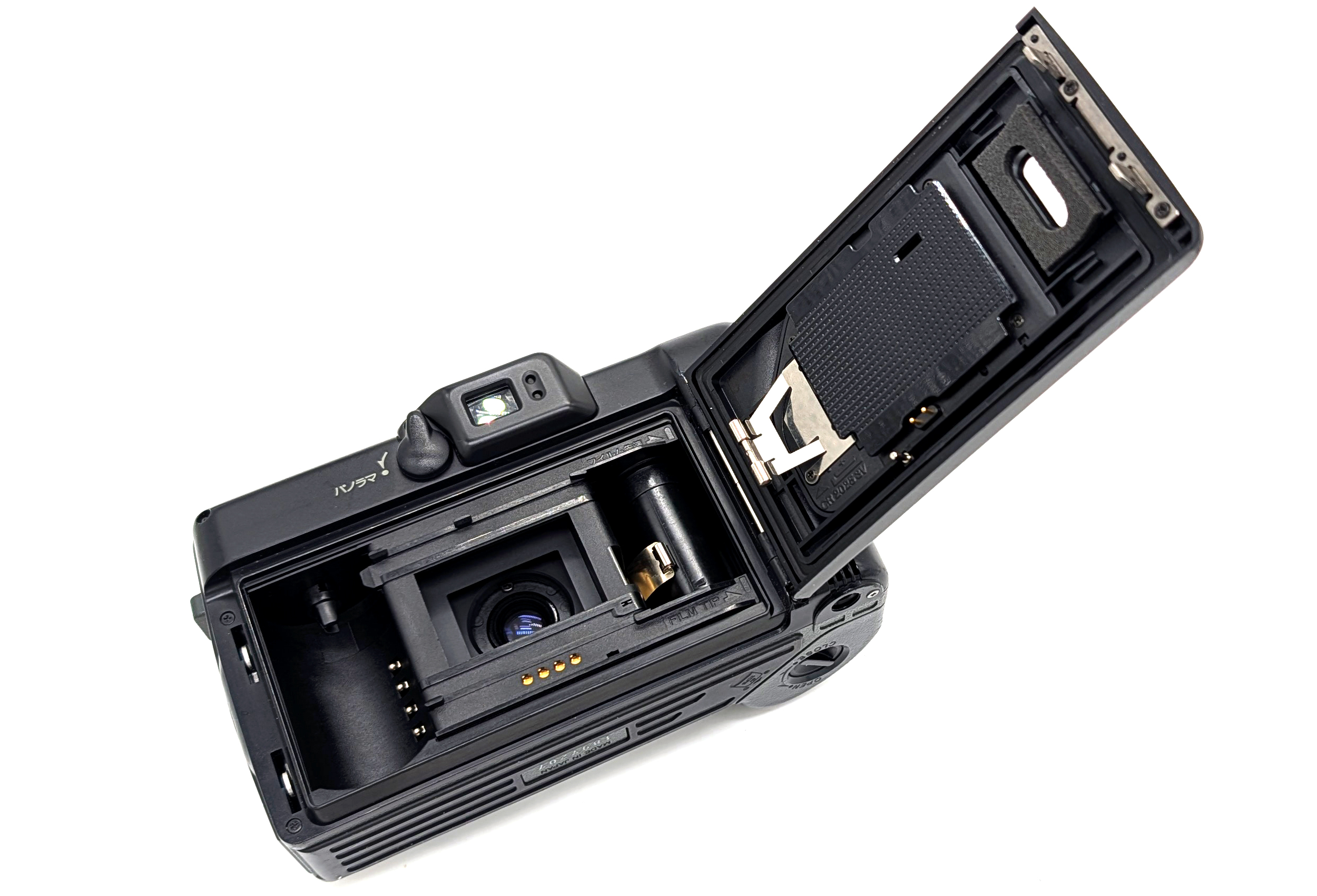
The panoramic mode is kind of cool, but it is achieved just by cropping the negative into a rectangle in the middle of the frame, something one can obviously in post with a regular shot. A switch by the viewfinder will close down the viewfinder and activate a mask inside the body.
It is difficult to find any 28mm fixed-lens autofocus point-and-shoot that can match the 28HG’s capabilities other than the significantly more expensive, yet more richly-featured Ricoh GR1 ($500+) Nikon 28Ti ($800+), and Minolta TC-1 ($800+). However, when shooting at 28mm, which has such a wide depth-of-field, comprehensive manual control over exposure settings means a bit less than shooting at 35mm or longer. In my opinion, critical work at 28mm is usually better accomplished with an SLR.
A tip for use of the 28HG is when in daylight conditions, immediately turn off the flash, as the auto flash can be occasionally unpredictable even where it appears that there is sufficient ambient light. Another one is that in hard contrast situations, force the flash on as daylight fill can do a decent job of filling in shadows at closer distances.
At the end of the day, the 28HG is a cool camera and recommended as a durable, easy-to-use point-and-shoot with a high-quality lens. As the final model in the series, although sometimes rare on the secondary market (perhaps because it may have never been exported outside Japan in sufficient quantities), it is probably worth holding out for over a 28 Wide or 28WB. If 28mm is not your bag, there are a variety of other Genba Kantoku models out there with different fixed lenses and zooms to try out.
Because the original manual for the 28HG may not have originally been translated into any other language, a Google-translated English PDF copy of it can be found here.